
Review by Sergio Rafael Figallo Calzadilla
The work of Camilo Villanueva is situated in a territory deeply connected to the thought of C. G. Jung and his exploration of the conscious, the unconscious, and that deeper stratum he referred to as the collective unconscious. In his pieces, archetypes emerge clearly, revealing images that seem to arise from a shared symbolic memory.
Although Jung introduced the concept of the collective unconscious, it is possible to draw a bridge to Carlos Castaneda’s interpretations in his dialogues with don Juan Matus and Genaro Flores, where this inner plane is conceived as a parallel reality or foreign installation. This connection between both perspectives has been the subject of my recent research, and it finds a direct resonance in the visual universe proposed by Villanueva.
His lines especially recall Castaneda’s early books —The Teachings of Don Juan, Journey to Ixtlán, and The Second Ring of Power— where the real and the symbolic intertwine to open access to a dimension that is not located outside, but within us, awaiting to be traversed.
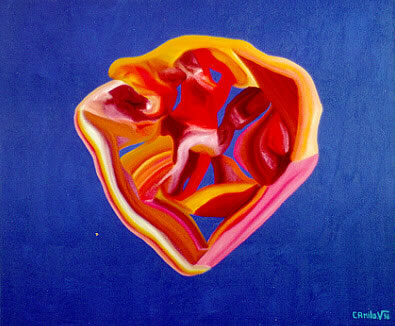
Figure 1
In the previous piece (Fig. 1), one perceives a superimposed reflection of the depths of the unconscious: a heart that is, at the same time, face, child, and pathways, suspended in a space-time folding back upon itself — a true containment of containments. The image operates like the opening of multiple windows on a computer, leading us layer by layer into deeper information. These are delicate strata that sustain and inhabit us. As in Chinese or Japanese painting, the work is aerial, subtle, a reflection of its own lightness.
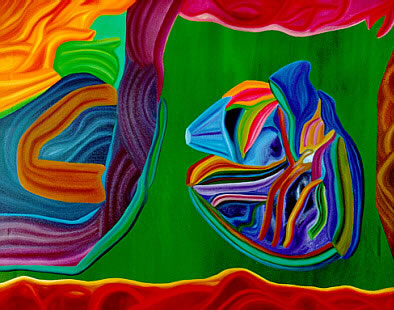
Figure 2
Similarly, the work recalls the manuscript known as The Red Book, conceived over many years by C. G. Jung in the Tower of Bollingen (Fig. 2). There, the heart becomes a symbol that embraces itself, withdraws, and separates in order to begin its process of individuation — or “self-becoming”, as Jung described that movement toward the inner wholeness of the being.
In the following piece (Fig. 3), the apple suspended from the Biblical Tree of Knowledge emerges, now transformed into a heart. The image is aquatic, alluding to the origin of life and to the notion of maternity within analytical psychology (Marie-Louise von Franz). At the same time, it is also nocturnal: it evokes the Dark Night of the Soul, as expressed in the mystical poetry of Saint John of the Cross.
In the referenced article, soon to be published, I propose precisely this fruit as the first archetype of humanity.
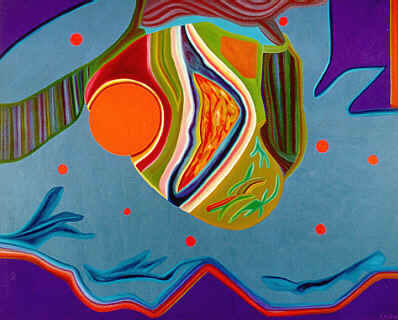
Figure 3
A question then arises—one that traverses beliefs, religions, philosophies, mysticisms, and sciences; a question addressed to the heart and to the resonance of the collective unconscious:
What is God? — using that name as a synthesis of its diverse cultural interpretations.
A possible approximation is that God is Space. A space that, if we take the infinity of the universe as reference, contains everything: the organic and the inorganic, the visible and the invisible. We inhabit, so to speak, the womb of God.
From this perspective, the work of Camilo Villanueva reveals the coexistence of both dimensions: that which forms and that which dissolves, that which is born and that which returns. Images that arise from the archetypal repository that constitutes us.
Congratulations on these artistic creations. The aesthetic experience they offer is profound, intimate, and respectful of its own mystery.
Note: The references to C. G. Jung or Carlos Castaneda mentioned here serve only as orienting points to illuminate certain symbolic correspondences. Villanueva’s work stands entirely on its own, without the need to be anchored to them. The observation follows — in the spirit of the Greek notion of epoché — the act of allowing the work to appear as it is, without prejudice or interference, and always from a place of respect for its intimacy.
CFPT Magazine, Art, door open toward transpersonality?

Muriel Rojas Zamudio
Artistic mediations and art therapy illuminated by psychoanalysis. Transpersonal therapy.
Download english ►
Téléchargez française ►
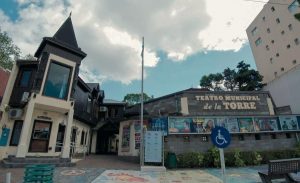
C a m i l o V i l l a n u e v a
“Transpersonal Paintings”
Municipal Exhibition Hall
January 2019
Pinamar, Province of Buenos Aires
More info…